
Sic Bo, that captivating dice game shimmering under the casino lights, often lures players with its promise of quick wins. But beneath the surface of flashing numbers lies a statistical truth: the house always has an edge. Many players jump in, driven by intuition, only to find their chips disappearing faster than they anticipated. The good news is, Sic Bo doesn’t have to be a purely luck-based endeavor.
This game, while seemingly simple, presents a complex landscape of betting options, each carrying a different house edge. Understanding these nuances and employing strategic betting is crucial for anyone serious about extending their playtime and improving their chances of walking away a winner. Minimizing the house edge isn’t about eliminating risk entirely (that’s impossible!), but about making informed decisions that shift the odds slightly more in your favor.
Consider this your guide to navigating the Sic Bo table with confidence. Forget superstitions and hunches; we’re diving deep into the math and strategies that actually matter. Learn how to identify the best bets, avoid the worst, and manage your bankroll like a pro. By the end, you’ll be equipped with the knowledge to play Sic Bo smarter, not harder, and maybe, just maybe beat the odds.
Sic Bo Basics: Understanding the Game
Sic Bo, an ancient Chinese dice game, is a game of chance involving three dice. The objective is to predict the outcome of the dice roll. The game is played on a specialized table with various betting options, each corresponding to different dice combinations and sums.
The Sic Bo Table Layout
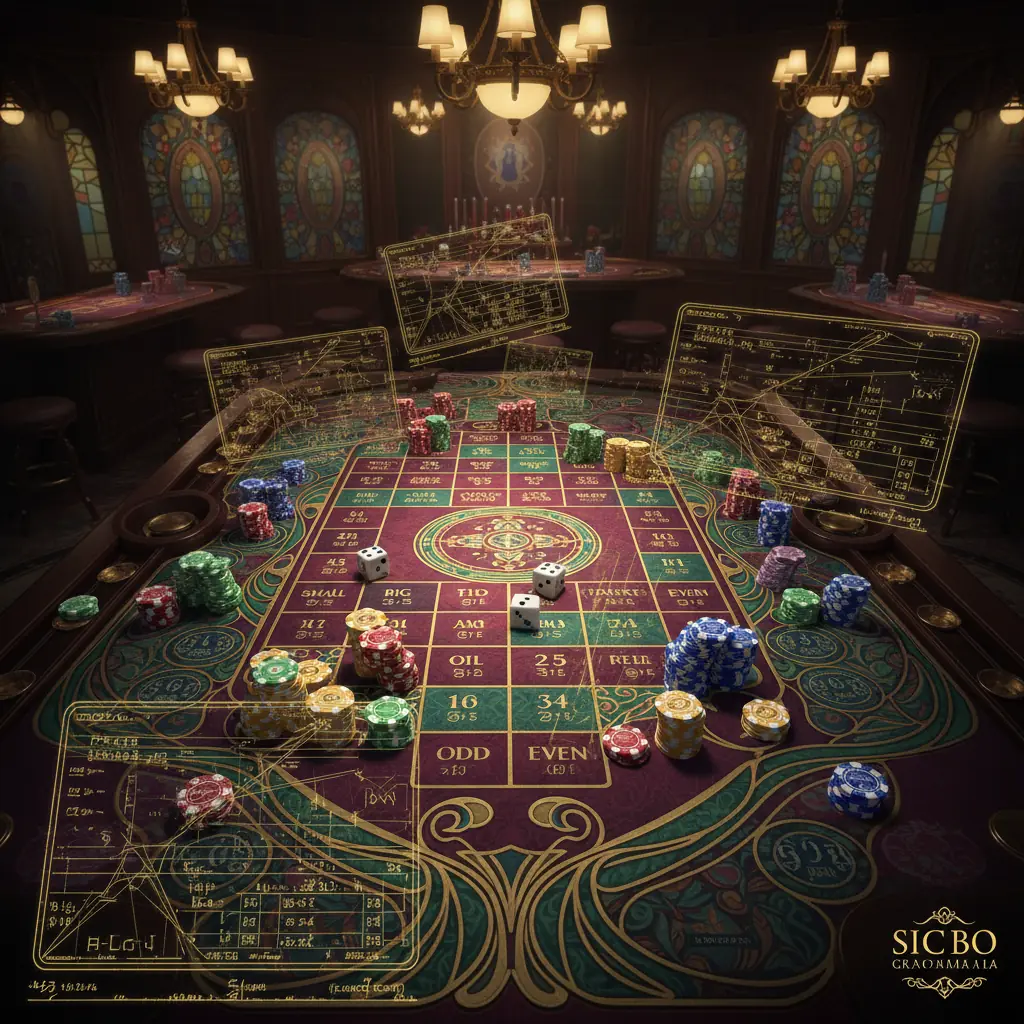
The Sic Bo table displays a layout of numerous betting areas. The layout indicates the various betting options available, such as specific totals (e.g., a total of 4, a total of 17), individual numbers appearing on at least one die, specific doubles (e.g., two 2s), and specific triples (e.g., three 6s). Understanding the table’s layout is crucial for placing informed bets. Players place their chips on the corresponding betting areas to indicate their predictions.
Common Bet Types: Odds and Payouts
Sic Bo offers a variety of bets, each with varying odds and payouts. Here are some common bet types:
- Big/Small Bets: A bet that the total of the three dice will be Big (11-17) or Small (4-10). These bets typically exclude triples. The payout is usually 1:1.
- Total Bets: A bet on a specific total of the three dice (e.g., a total of 8). Payouts vary depending on the total, with less likely totals offering higher payouts.
- Double Bets: A bet that a specific number will appear on two of the three dice (e.g., two 3s). Payouts are generally in the range of 8:1 to 10:1.
- Triple Bets: A bet that a specific number will appear on all three dice (e.g., three 5s). These bets offer high payouts.
- Any Triple Bet: This is a bet that any triple will be rolled (e.g., three 1s, three 2s, three 3s, etc.). This bet pays out if any triple appears.
- Combination Bets: Betting on any two specific numbers to appear on any of the dice.
Payout structures can differ slightly depending on the casino, so understanding the specific rules and payouts at the chosen gaming location is important.
Decoding the House Edge
The house edge is the casino’s statistical advantage in any game. It’s the percentage of each bet the casino expects to retain in the long run. Think of it as the built-in profit margin for the house. A lower house edge theoretically gives the player a better chance of winning, while a higher house edge favors the casino.
In Sic Bo, the house edge isn’t uniform across all bet types. It varies considerably, impacting your potential returns. For instance, simple bets like Big or Small might have a relatively low house edge, while specific triple bets carry a much higher one. This disparity is crucial to understand when formulating your Sic Bo strategy. Being aware of these differences is key to making informed betting choices and managing your bankroll effectively.
The Return to Player (RTP) is directly linked to the house edge. RTP represents the percentage of wagered money a game is expected to return to players over time. The house edge is simply 100% minus the RTP. For example, if a Sic Bo bet has an RTP of 97.22%, the house edge is 2.78%.
The Math Behind the Edge
The house edge is ultimately calculated from probability. Probability in gambling terms, refers to the likelihood of a specific outcome occurring. This is often expressed as the ratio of favorable outcomes to the total number of possible outcomes. The house edge is the difference between the true odds of an event occurring and the odds that the casino pays out. The less probable you are to hit the right numbers, the more money the casino can expect to keep.
Low-Risk Strategies: Minimizing the House Edge
For those cautiously approaching the Sic Bo table, or just starting out, the most effective strategy revolves around focusing on bets with a low house edge. While Sic Bo inherently favors the casino, understanding where the odds are less stacked against you can significantly extend your playtime and increase your chances of walking away a winner. The Big/Small and Combination bets are prime examples of this approach. This isn’t a guaranteed path to riches, but it’s a sensible way to manage risk and enjoy the game without unnecessary financial strain. Think of it as smart Sic Bo – playing to enjoy the thrill, not chase impossible dreams.
The beauty of this strategy lies in its simplicity. There’s no need to memorize complex patterns or employ complicated betting systems. It’s about recognizing where the odds offer a slightly better chance and capitalizing on those opportunities. While high-risk bets might offer tempting payouts, they come with a significantly higher house edge, making them far less sustainable in the long run. In fact, I once saw a new player stick exclusively to Big/Small bets during an entire evening at the casino. While not a massive win, they consistently chipped away at the house edge, ultimately leaving with a small profit – a testament to the power of a disciplined, low-risk approach.
Focusing on Big/Small
The Big/Small bets are cornerstones of a low-risk Sic Bo strategy. These bets involve wagering on whether the total of the three dice will be a “Big” number (11-17) or a “Small” number (4-10). Critically, totals of 3 and 18 are excluded, as those trigger specific Triple bets and result in a loss for Big/Small wagers. The house edge on Big/Small bets hovers around 2.78%, making it among the lowest available in Sic Bo. Mathematically, there are 108 possible combinations that result in a “Big” outcome and 108 that result in a “Small” outcome, out of the total 216 possible combinations. This near 50/50 chance is why the house edge is minimal. However, don’t be fooled into thinking it’s a sure thing. The house always has an edge, and streaks of unfavorable rolls can still occur. The drawback is a lower payout compared to other more risky bets.
Playing the Combination Bet
The Combination bet allows you to wager on any two specific numbers appearing on the three dice. For example, betting on a combination of 2 and 5. The house edge here is higher than Big/Small (usually around 8.33%), but it’s still significantly lower than many other Sic Bo bets. There are 15 different combination bets possible, offering a decent spread of options. The probability of hitting a specific combination is more favorable than hitting a specific Triple, for instance. In practical terms, Combination bets offer a balance between risk and reward. You’re not betting on a long shot, but the payout is more substantial than a Big/Small win. A drawback should be considered: you are betting on two specific numbers to appear and there are more possible dice combinations for bets with the same amount staked.
Advanced Strategies and Betting Systems
While basic Sic Bo strategies can enhance your gameplay, some players explore more complex betting systems. However, approaching these systems with extreme caution is crucial. Understand they can be incredibly risky, especially in a game like Sic Bo, which already carries a significant house edge.
The Martingale System: Proceed with Caution
The Martingale system operates on a negative progression. The idea is simple: after each loss, you double your bet. The theory suggests that when you eventually win, you will recover all previous losses plus a small profit. For instance, if you start with a $5 bet and lose, you then bet $10. If you lose again, you bet $20, and so on. While this may seem appealing, the inherent risk lies in the rapid escalation of bet sizes. A losing streak can quickly deplete your bankroll, and Sic Bo’s high house edge makes those streaks more probable. This system is extremely dangerous for Sic Bo and is generally not recommended.
The Paroli System: Proceed with Caution
The Paroli system takes the opposite approach, using a positive progression. You double your bet after each win, aiming to capitalize on winning streaks. For example, if you start with a $5 bet and win, you bet $10 on the next round. If you win again, you bet $20. The idea is to maximize profits during hot streaks while minimizing losses during cold streaks. However, a single loss can wipe out all the accumulated gains from previous wins. Similar to the Martingale, it’s a high-risk approach that isn’t ideal for Sic Bo due to the game’s volatility.
Bankroll Management
Effective bankroll management is the cornerstone of sustainable success in any gambling endeavor. It’s not just about how skilled you are at predicting outcomes; it’s about how responsibly you handle your capital. Think of your bankroll as your business’s operating budget; mishandling it can lead to quick ruin, no matter how brilliant your strategies are.
Before even placing your first bet, determine a specific bankroll. This is the total amount of money you’re comfortable potentially losing. Critically, it should be separate from essential funds needed for bills or daily living expenses. Once you’ve established it, rigidly adhere to it.
Next, set crystal-clear loss limits and profit targets for each session. A loss limit is the maximum amount you’re willing to lose in a single session; walking away once you hit it prevents chasing losses driven by emotion. Conversely, a profit target defines when you’ll stop playing after a successful run. This avoids the temptation to keep betting until you surrender your gains.
A practical technique is dividing your bankroll into smaller betting units. This method supports you to weather losing streaks and capitalize on winning streaks without risking too much on any single bet. It should be calculated based on your risk tolerance and the volatility of the games.
Resist the urge to chase losses. Increasing your bet sizes to recoup lost money rarely works and usually accelerates losses. A vital point is to withdraw your winnings regularly. It keeps a tangible record of your success and prevents you from reinvesting all your profits, potentially losing them back. I recall a time when a disciplined approach saved me from a potentially disastrous situation. After a series of unlucky events, I was tempted to increase my bet sizes to recover the losses. However, sticking to my bankroll management and loss limits helped me to avoid a significant loss.

Online Sic Bo: Special Considerations
The shift of Sic Bo to online casinos introduces unique aspects that players should consider. Unlike physical casinos, online platforms offer a dynamic environment with diverse software providers, each presenting its own variations of the game. Bonuses and promotions become a significant factor, potentially enhancing winnings, while understanding licensing and regulations is crucial for a secure gaming experience.
Bonuses and Promotions
Online casinos frequently attract players with deposit and sign-up bonuses. These promotions can provide additional funds to play Sic Bo, increasing the chances of winning. However, these bonuses often come with wagering requirements, dictating the amount that must be wagered before winnings can be withdrawn. It’s very important to pay close attention to any game restrictions associated with bonuses, as some may not apply to Sic Bo.
Licensing and Regulations
Gambling regulations and licensing ensure a fair and secure environment for online Sic Bo players. Reliable casinos operate under strict licenses, guaranteeing adherence to industry standards and practices. The RTP (Return to Player) percentage indicates the average return a player can expect over time, so checking these values is another good strategy. Moreover, the integrity of the game depends heavily on the Random Number Generator (RNG), a system that ensures random game outcomes. For players seeking a more immersive experience, Live Dealer Sic Bo offers the advantage of interacting with real dealers in real-time, adding a layer of transparency and trust to the online game.
Conclusion
In conclusion, mastering Sic Bo involves a blend of understanding the house edge, employing strategic betting, and diligent bankroll management. Recognizing the house edge associated with each bet is crucial for making informed decisions and minimizing potential losses. Opting for bets with lower house edges, like Big or Small, increases the chances of prolonging gameplay and enjoying the experience, even if it means smaller potential payouts.
Strategic betting, such as combination bets, can add a layer of calculated risk to your gameplay, allowing for a balance between risk and reward. However, it’s important to remember that no strategy can guarantee a win in Sic Bo. The game inherently favors the house, and outcomes are largely determined by chance.
Effective bankroll management is the cornerstone of responsible gambling. Setting limits on how much money and time to spend, and sticking to those limits, can prevent Sic Bo from becoming a financial burden. Treat Sic Bo as a form of entertainment, not a source of income, and only gamble with what can afford to lose.
By applying these principles – understanding the house edge, employing strategic betting, and practicing responsible bankroll management – can enhance the Sic Bo experience. Armed with knowledge and a disciplined approach, approach the game strategically and responsibly.